
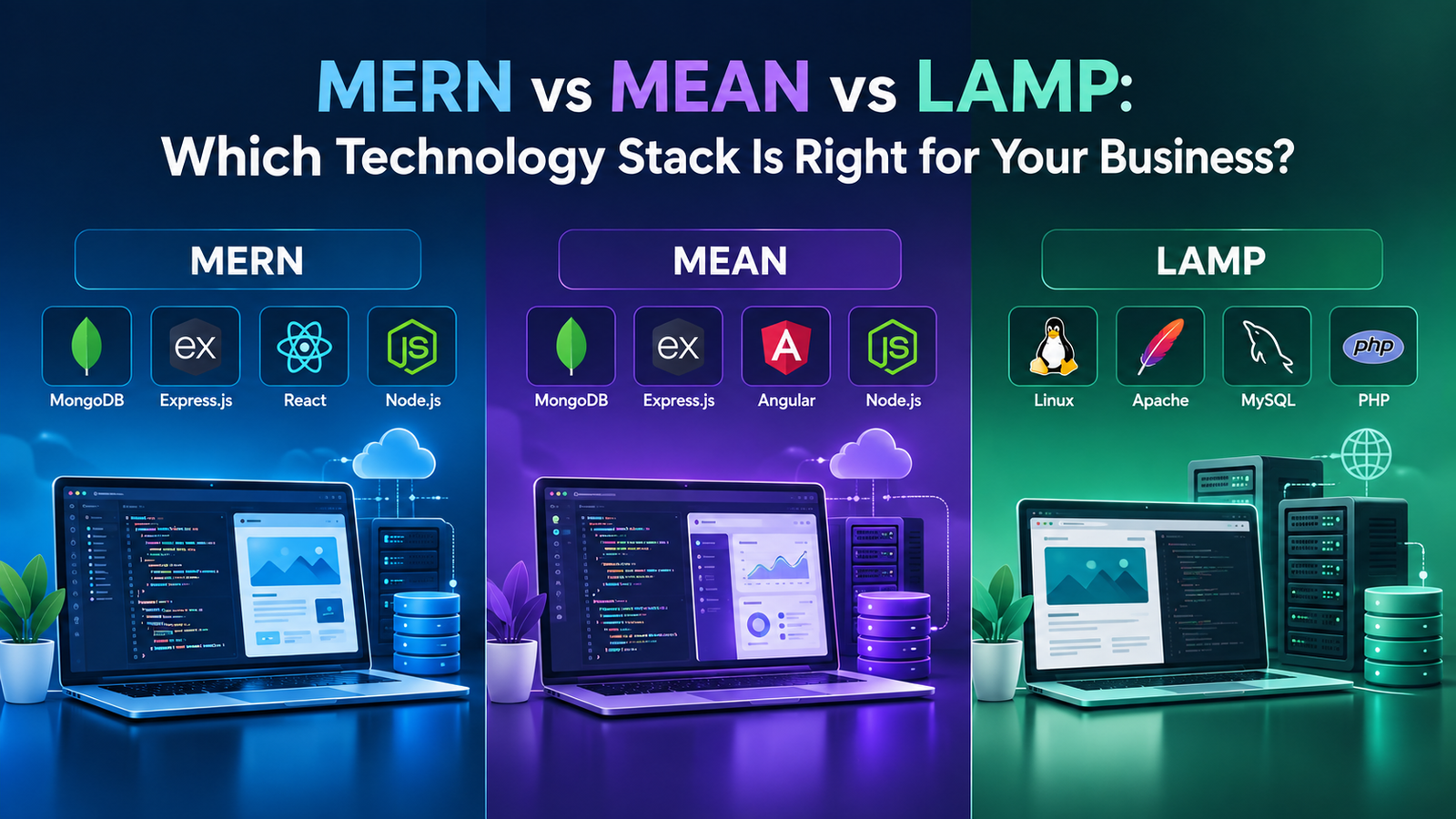
Choosing the right technology stack is one of the most important decisions when developing a modern web application. The technology stack influences development speed, scalability, performance, maintenance, security, and long-term business growth. Among the many options available today, MERN vs MEAN vs LAMP is a common comparison for businesses planning new web applications or upgrading existing platforms.
MERN, MEAN, and LAMP each use different technologies and development approaches. While MERN and MEAN are JavaScript-focused stacks, LAMP combines Linux, Apache, MySQL, and PHP to create a reliable environment for web development. Understanding these differences can help businesses select a technology stack that aligns with their project requirements.
For businesses working with an experienced Full Stack Development company such as App Scoop, evaluating the project’s goals, technical requirements, scalability expectations, and budget can make the selection process more straightforward.
Understanding Technology Stacks
A technology stack is a combination of programming languages, frameworks, databases, servers, and other technologies used to build and operate a software application. A typical web application requires both frontend and backend technologies along with a database and server environment.
The frontend handles what users see and interact with, while the backend manages business logic, databases, APIs, authentication, and server-side operations.
A well-selected technology stack can help development teams create applications that are easier to maintain, scale, and improve over time.
What Is MERN Stack?
MERN stands for MongoDB, Express.js, React, and Node.js. It is a JavaScript-based technology stack widely used for developing dynamic web applications.
MongoDB
MongoDB is a NoSQL database that stores information in flexible document-based structures. This approach can be useful for applications that handle changing or large volumes of data.
Express.js
Express.js is a backend framework built on Node.js. It provides tools for developing APIs, handling requests, managing routes, and implementing backend functionality.
React
React is a frontend JavaScript library used to create interactive user interfaces. Its component-based architecture allows developers to create reusable UI elements and efficiently manage complex interfaces.
Node.js
Node.js provides the runtime environment for executing JavaScript on the server. It enables developers to use JavaScript for both frontend and backend development.
Together, these technologies make MERN a popular choice for businesses looking for flexible and JavaScript-centered application development.
What Is MEAN Stack?
MEAN stands for MongoDB, Express.js, Angular, and Node.js. Like MERN, it uses JavaScript throughout the development process, but it uses Angular instead of React for frontend development.
MongoDB
MongoDB provides the database layer and offers document-based data storage suitable for applications with flexible data requirements.
Express.js
Express.js handles backend functionality, API development, routing, and server-side application requirements.
Angular
Angular is a comprehensive frontend framework developed by Google. It provides built-in tools and structures for developing complex web applications.
Node.js
Node.js powers the server-side environment and allows developers to use JavaScript for backend operations.
MEAN can be suitable for larger applications where developers want a structured frontend framework with built-in features and conventions.
What Is LAMP Stack?
LAMP stands for Linux, Apache, MySQL, and PHP. It is one of the long-established technology stacks used for web development.
Linux
Linux provides the operating system layer for the application and server environment. It is widely used for hosting web applications because of its flexibility and extensive ecosystem.
Apache
Apache is a widely used web server that processes client requests and serves web content.
MySQL
MySQL is a relational database management system that organizes information using structured tables and relationships.
PHP
PHP is a server-side programming language commonly used to build dynamic websites and web applications.
LAMP remains relevant for businesses that require mature technologies, relational database functionality, and established hosting environments.
MERN vs MEAN vs LAMP: Key Differences
The comparison between these three stacks becomes easier when their primary technologies and development approaches are examined.
Frontend Technology
MERN uses React, while MEAN uses Angular. LAMP traditionally uses PHP for server-side development and can work with various frontend technologies.
React provides flexibility through its component-based approach, while Angular offers a more comprehensive framework with many built-in development features.
Backend Technology
Both MERN and MEAN use Node.js with Express.js for backend development. LAMP uses PHP with Apache on a Linux environment.
The choice can depend on the development team’s experience and the application’s technical requirements.
Database
MERN and MEAN commonly use MongoDB, which is a NoSQL database. LAMP generally uses MySQL, a relational database.
MongoDB can be useful when data structures need flexibility, while MySQL can be suitable when applications require structured relational data and complex relationships.
Development Language
MERN and MEAN primarily use JavaScript across frontend and backend development. LAMP commonly uses PHP on the backend while frontend development may involve JavaScript, HTML, CSS, and other technologies.
Using JavaScript across the application can simplify development for teams specializing in the JavaScript ecosystem.
MERN vs MEAN vs LAMP for Business Applications
Businesses should avoid selecting a stack simply because it is popular. The right option depends on the application’s objectives and technical requirements.
When MERN Can Be Considered
MERN can be considered for applications requiring interactive interfaces, flexible development, real-time functionality, and scalable architectures.
It can work well for:
- Interactive web applications
- Startup platforms
- Customer portals
- Real-time applications
- E-commerce interfaces
- Content-driven platforms
- Single-page applications
Its JavaScript-based environment can also make it convenient for teams already experienced with modern JavaScript development.
When MEAN Can Be Considered
MEAN may be suitable for businesses developing large and structured applications where Angular’s comprehensive framework can support development requirements.
It can be considered for:
- Enterprise applications
- Business management platforms
- Complex dashboards
- Large-scale web applications
- Applications requiring structured frontend architecture
Angular’s built-in features can provide developers with a consistent framework for managing complex frontend projects.
When LAMP Can Be Considered
LAMP can remain a practical option for businesses that need a mature and widely supported development environment.
It may be considered for:
- Content management systems
- Business websites
- E-commerce websites
- Data-driven applications
- Traditional web applications
- Applications requiring relational databases
Its established ecosystem also means many developers and hosting providers are familiar with LAMP-based environments.
Performance and Scalability Considerations
Performance is an important factor when comparing MERN vs MEAN vs LAMP.
MERN and MEAN use Node.js, which is designed around an event-driven architecture. This can be useful for applications that handle many concurrent requests, particularly where real-time interactions are important.
LAMP can also support high-traffic applications when properly configured and optimized. Performance depends not only on the technology stack but also on application architecture, database design, caching, hosting infrastructure, and code quality.
Scalability should therefore be evaluated according to the specific application’s expected traffic and workload.
Security Considerations
Security should be considered from the beginning of the development process regardless of the selected stack.
Developers should implement secure authentication, authorization, input validation, encryption, secure API practices, dependency management, database security, and regular updates.
MERN and MEAN applications may require careful management of JavaScript dependencies and API security. LAMP applications similarly require secure PHP development, server configuration, database protection, and regular software updates.
An experienced Full Stack Development team can integrate security practices across frontend, backend, database, and infrastructure layers.
Development and Maintenance
Another important consideration is how easily a technology stack can be developed and maintained over time.
MERN and MEAN can benefit teams that already have strong JavaScript expertise. Developers can use JavaScript across different layers of the application, potentially reducing the need to switch between programming languages.
LAMP has a mature ecosystem and extensive documentation. Businesses can also find developers with experience in PHP, MySQL, Apache, and Linux.
Maintenance requirements will ultimately depend on application complexity, code quality, documentation, testing practices, and development standards.
How App Scoop Can Support Full Stack Development
Selecting the appropriate technology stack requires more than simply comparing programming languages and frameworks. Businesses should consider their users, application functionality, data requirements, expected growth, integrations, security needs, and long-term maintenance plans.
App Scoop provides Full Stack Development services designed to support businesses throughout the development lifecycle. From frontend interfaces and backend systems to APIs, databases, integrations, and application architecture, a full-stack approach can help businesses build connected digital solutions.
The development process can begin with understanding business requirements and selecting technologies based on the project’s actual needs. This approach helps avoid choosing a technology simply because it is currently popular.
Factors to Consider Before Choosing a Technology Stack
Before deciding between MERN, MEAN, and LAMP, businesses should evaluate several important factors.
Project Requirements
Start by identifying the application’s core features, expected users, integrations, data structure, and performance requirements.
Development Team Expertise
The team’s existing knowledge can influence development speed and maintenance. Choosing technologies that align with available expertise can simplify development.
Scalability Requirements
Businesses expecting significant growth should consider how easily the application can scale as users, transactions, and data increase.
Budget and Timeline
Development costs can vary depending on application complexity, developer availability, infrastructure, and long-term maintenance requirements.
Third-Party Integrations
If the application needs payment gateways, CRM systems, APIs, analytics platforms, or other services, the selected stack should support those integrations effectively.
Long-Term Maintenance
Technology selection should consider future updates, security patches, developer availability, and the ability to introduce new features.
Making the Right Technology Decision
There is no universal technology stack that is perfect for every business. MERN vs MEAN vs LAMP should be evaluated based on the specific requirements of the project rather than popularity alone.
MERN can be considered when businesses want a flexible JavaScript-based development environment with React. MEAN can be appropriate for projects that benefit from Angular’s structured framework. LAMP can remain a practical choice for applications that require a mature PHP and MySQL ecosystem.
The right decision should take into account application functionality, development expertise, scalability, performance, security, budget, and long-term maintenance.
Conclusion
The comparison of MERN vs MEAN vs LAMP demonstrates that each technology stack offers different approaches to building web applications. MERN provides a JavaScript-focused environment centered around React, MEAN combines JavaScript technologies with Angular, while LAMP offers a mature ecosystem based on Linux, Apache, MySQL, and PHP.
For businesses planning a new application, technology selection should begin with business and technical requirements. Working with an experienced Full Stack Development team can help organizations evaluate these requirements and build a suitable technical architecture.
With its focus on modern software solutions, App Scoop can help businesses plan and develop web applications using technologies that align with their project objectives, functionality, scalability, and long-term development needs.